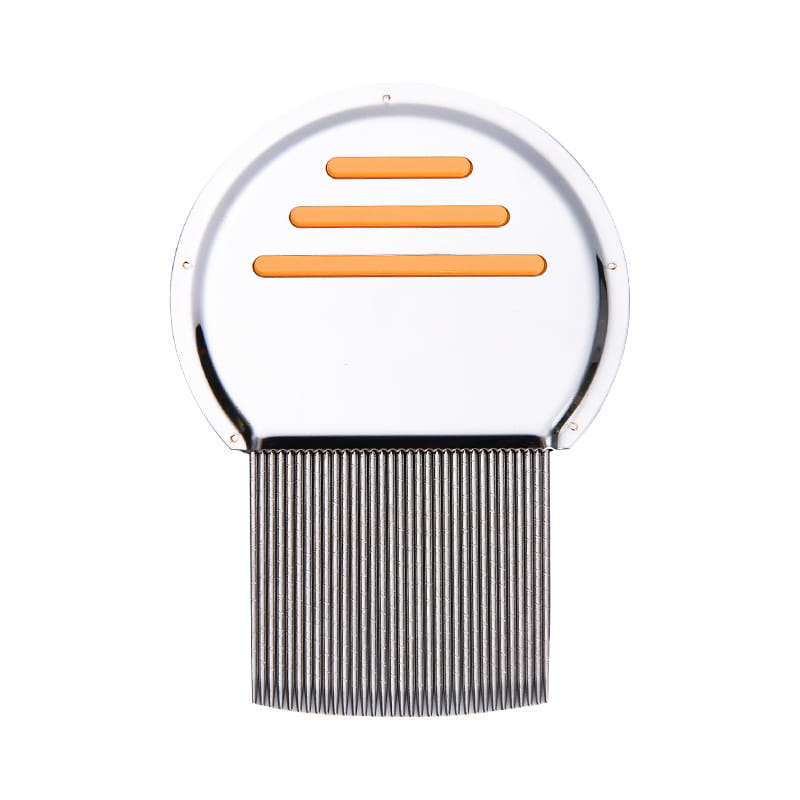
The handle of the lice removal comb is made of 304 stainless steel, the steel needles are laser welded, the old strength is 500N and it will not loosen, the needle spacing is 0.08-0.09mm, the needle gap is small and can tightly grasp the young insects and eggs, there are four different shapes of needles, different shapes, different lice removal effects, and patterned needles are better for lice removal! The all-stainless steel lice comb is a high-quality tool designed to remove lice, fleas and other tiny parasites from hair and pet hair. This comb is made of high-quality stainless steel with good durability and corrosion resistance, ensuring that it will not rust or deform under frequent use. The comb teeth are precisely arranged and evenly spaced, which can effectively capture and remove tiny parasites and eggs without damaging the scalp or hair.
Multi-function Lice Comb: Safe and Effective Lice Removal A multi-function lice comb is the most re...
READ MOREIntroduction to Lice Control Tools Lice infestations can be a persistent and uncomfortable problem, ...
READ MOREOverview of Multifunctional Lice Combs Multifunctional lice combs are grooming tools designed to rem...
READ MOREGeneral Understanding of Dense-Tooth Lice Combs Dense-tooth lice combs are designed with closely spa...
READ MOREGeneral Overview of Lice Combing Tools Lice combs are commonly used tools for detecting and removing...
READ MOREIntroduction to Multi-Functional Lice Combs Multi-function lice combs have become essential tools fo...
READ MOREWhat steps are taken to ensure uniform spacing on all-stainless steel lice combs?
To ensure uniform spacing of the all-stainless steel lice comb, the company took a meticulous and multifaceted approach that included advanced manufacturing processes, stringent quality control measures, and continuous improvement.
CAD Modeling: The company first used computer-aided design (CAD) software to create an accurate digital model of the all stainless steel lice comb to ensure that the needle spacing (0.08–0.09mm) was uniform and within the required specifications. These designs were carefully analyzed to ensure that they would optimize the removal of lice and nits without damaging the scalp or hair.
Prototype Development: Prototypes of the all stainless steel lice comb were manufactured and tested before mass production. This step allowed engineers to confirm that the needle alignment and spacing were accurate and effective, and to make any necessary adjustments to the design early in the process.
304 Stainless Steel: The company used 304 grade stainless steel for the comb handle and needles, a material chosen for its durability, corrosion resistance, and consistent material properties. The uniform material quality reduces variations in the production process and ensures that the needles maintain their shape and alignment. Pre-treated Steel: The raw material is pre-treated to eliminate defects that could cause uneven or inconsistent spacing during the manufacturing process.
Automated Machinery: The company uses high-precision automated manufacturing equipment to align and place the needles at consistent spacing. Automation minimizes human error and ensures precise spacing is maintained in high-volume production. Laser Welding: The needles are fixed to the comb handle using advanced laser welding technology. This technology ensures that the needles are permanently fixed in the specified position and can withstand large stresses (up to 500N of tensile strength) without loosening or shifting, which is critical to maintaining uniform spacing. Precision Stamping and Cutting: The needles are cut and formed using precision stamping or CNC (computer numerical control) machining processes. These methods ensure that each needle of the all stainless steel lice comb is the same size and shape, resulting in evenly spaced and well-aligned comb teeth.
Online Monitoring: During the manufacturing process, the company uses automated sensors and optical systems to continuously monitor the placement and alignment of the needles. These systems can detect and correct even the slightest deviations in real time.
Periodic Sampling: Finished products are randomly selected from the production batch for detailed inspection. These inspections may include measuring the needle spacing and alignment using magnification tools or laser measurement equipment to confirm that they meet exact specifications.
Visual Inspection: Each all stainless steel lice comb undergoes a thorough visual inspection, usually under a magnifying glass, to ensure consistent and aligned needle spacing throughout the all stainless steel lice comb. Functional Testing: The comb's performance is tested using simulated conditions, such as hair samples with artificial lice or lice eggs. This step ensures that the spacing is effective in capturing and removing even the smallest parasites. Durability Testing: Tensile strength testing is performed to ensure the needles remain firmly attached under pressure, preventing any movement that could break the spacing.

Copyright © Yuyao safe & Beauty Lice Comb Factory All
Rights Reserved
 Custom All stainless steel lice comb series Suppliers


 Español
  中文简体
中文简体